mmcirvin: (Default)
So there's a lot of controversy going on in the roller-coaster-fan community about the big coaster YouTubers fluffing Six Flags Qiddiya, the massive Saudi Arabian amusement-park project that includes a coaster over 600 feet tall. I don't think I'd participate in that, but I feel a bit sheepish about being too critical, since when all this broke I was, myself, busy having adventures in a country that is no bastion of liberal democracy. I do think it's also difficult for an American to throw stones: I think the current regime in the Republic of Singapore does care more about basic competence and the well-being of its residents (and certainly about maintaining a diverse, tolerant, multi-ethnic culture) than the one currently in federal power here.

That said... we spent a day of our trip on Sentosa, an island south of the main island of Singapore that allegedly used to be a hideout for pirates but today is a massive cluster of resorts. I'd been here before but had not gone to Universal Singapore, the highest-profile park there. My kid was not interested--but this time, she's old enough that she could go off and do other stuff with a friend who had come along.

The Singapore park has a reputation for being the runt of the Universal chain, and it kind of is, but there's plenty of interest there. Unfortunately the park was slammed with crowds, queues got very long and we didn't have a lot of time. At rope drop, we prioritized the things we wanted to ride together, so the waits there were relatively short. The first ride we did was Revenge of the Mummy, an indoor dark-ride/coaster hybrid memorialized by Huang Yongquan here:


I haven't ridden the US versions of Revenge of the Mummy but I understand they have more of a metafictional, fourth-wall-breaking hook, about the set of a fictitious sequel to the Brendan Fraser Mummy being cursed by the actual Mummy. This one is more straightforward: some theorize that it's the story of the movie they were making in the other rides. But I'm not sure it's all that coherent. There are a lot of good scary effects, but it felt like it ended kind of abruptly, as if the actual finale were missing. I suppose I can't complain too much about the plotline of a roller coaster.

It is more of a roller coaster, and less of a pure dark ride, than, say, Escape from Gringotts at Universal Orlando. There's some speed and force in the coaster segments, a brief backwards section and a surprise turntable transition.

Next we did the Jurassic Park Rapids Adventure, a version of the Jurassic Park/World water ride that exists at the other Universal resorts, but, uniquely, this one is a raft ride rather than a flume. Here's XtremeCoasters' POV:


As a raft ride alone this is middling but as a storytelling ride, it's superb. You can guess what happens: it starts out as a majestic ride through dinosaur habitats at Jurassic Park (similar to a real-life water ride we'd ridden at the River Wonders zoo/aquarium earlier in the week!), then things go horribly wrong; the dinosaurs get loose, floodwaters sweep you into a dino-infested "backstage" area where you're not supposed to be, and you end up menaced by an overhead Tyrannosaurus while ascending an elevator lift to the climactic drop.

Finally, despite a brutal 110-minute wait, I just had to try out the park's most thrilling ride, the roller coaster Battlestar Galactica: Cylon. XtremeCoasters again:


This big Vekoma coaster is a bit of a time capsule by now--it went up in 2010 when the revived Battlestar Galactica series was a big deal, and it had two dueling tracks, a non-inverting ride representing the Human side in the conflict and an inverted looper for the Cylons. I only had time to be a Cylon. The long wait was in part because of technical and operations issues: the ride got overhauled in 2013-15, replacing the originally four-across trains with lighter, two-across ones, which reduced capacity but I suspect were needed to reduce structural stresses on the ride. They were also doing metal-detector tests for loose items at the beginning AND end of the queue. I was wondering if they'd detect my metal knee (I am a bit of a Cylon myself) but it wasn't a problem.

The queue, at least, was all indoors and air-conditioned, and had clever shiny-chrome/biomechanical-horror theming and amusing video spiels from Michael Hogan and Tricia Helfer as their characters in the show. And I made friends in the queue: a guy from Pakistan who was there with his daughters and bailed after about half an hour of waiting, and a very nice family who gifted me with a front-seat ride because their kid was too nervous to ride in the front.

After all that, the coaster itself turned out to be really good, way better than I expected! It started with a powerful, fast LSM launch up the lift hill (I'd forgotten it did that so this was a surprise), and the inversions were all as smooth as they were forceful, with a fighter-jet feeling and none of the jank people associate with early Vekoma coasters. One maneuver dipped into a mist-filled trench below ground level. It was interesting to see that the track itself had the "new Vekoma" design they use with their current major coasters--it must have been one of the earliest ones of those.

My spouse saw the "Lights, Camera, Action!" special-effects show, and some roaming performers playing "Waterworld" characters, while I was waiting for this--she enjoyed them a lot. After I was free of this ride, we needed to get lunch somewhere but found, mysteriously, that most of the food joints at the park were closed--the only one available was a counter-service pizza place. Not sure what was going on there.

But we had our pizza, then headed over to the somewhat less slammed Adventure Cove Waterpark, a repeat favorite. The big attraction here is their amazing lazy river, part of which goes through sea-life tanks--here's Theme Park Family World Wide:


Good times, all in all.
mmcirvin: (Default)
We spent the past week in Denmark, split between a couple of days in Aarhus (the biggest city in Jutland, the European mainland part) and a few in Copenhagen. Honestly, one of the main reasons I even suggested going to Denmark was to experience Copenhagen's world-famous urban amusement park, Tivoli Gardens, and its amazing bucket-list coaster Rutschebanen, a side-friction coaster built in 1914.

We'd had a stretch goal of also visiting Aarhus's amusement park Tivoli Friheden on the afternoon of our arrival there, but between bad weather and exhaustion that did not happen. We did spend the following sunny day at Aarhus's amazing historical reconstruction park Den Gamle By. That reminded me a bit of Colonial Williamsburg, but with a broader sweep, with restored buildings ranging from the 16th century to the 21st (there's a surprisingly big section of early-1970s streets, businesses and apartments, including a hippie commune and an electronics shop full of glorious analog hi-fi equipment, and a little section recreating for posterity a street from the 2010s with a dying Blockbuster Video). There are also several historical museums within the park. Highly, highly recommended.

The weather in a Danish autumn is at least as mercurial as in New England and you just have to work around it. We went to indoor attractions (mostly art museums) on the rainy days and hit Copenhagen's Tivoli on a relatively good one, which started out sunny with a little drizzle later. It was the beginning of Tivoli's Halloween event, so they were open late, but the weather got worse as the afternoon went on and we were getting tired, so we didn't stay super late. We're not big on Halloween haunts (I think they converted the funhouse to one; I'd like to hit it during the summer season) but the pumpkiny decor everywhere was beautiful.

I went directly to Rutschebanen and found it not yet operating, though there were workers milling about on the ride so that was a promising sign. Given that we didn't hit Tivoli Friheden, there was an opportunity for Rutschebanen to be my 40th cred, but, eh, that kind of numerological pickiness doesn't rule me. Instead, we decided to hit some rides that both of us could enjoy: the 70-year-old cast-iron Ferris wheel, the gorgeous, colorful bumper cars (which have a long, chaotic cycle), and my actual 40th cred, the powered Mack family coaster Mælkevejen (here is Amuseaholics' POV):


This is a fairly new ride that packs more force than you'd expect. It's a long ride, since they give you THREE laps around the course, and the layout is long enough that at an American park they probably would have probably gotten away with one lap. There is whimsical space-rocket theming about a transit service circling the Milky Way. It's a bunch of turns and helixes, all elevated enough that you get nice views of the park and the surrounding neighborhood, but we both got off a little dizzy.

Rutschebanen was still down so we went on the ride underneath it, an adorable dark boat ride called Minen (here's Attractions Magazine's ride-through):


This has a Ghost Hunt-style target-shooting element that I think was added after the fact, but it's not scored and isn't really the main focus of the ride. It's all about the cute funny-animal animatronics. We got multiple rides on this one.

I was steeling myself for Rutschebanen to never get running (this kind of disappointment is part of being a coaster fan), but, nah, they got this eleventy-one-year-old classic going before too long and I indeed got three rides on it that day. Here's CoasterForce's POV:


Rutschebanen (that just means Roller Coaster) is currently the second-oldest operating coaster in the world (since Lakemont's Leap-The-Dips has not been running lately and has an uncertain future). It is a side-friction coaster, that is, one that runs in a kind of trough with road wheels and side wheels that keep it centered on the track, but no upstop wheels keeping it from flying away. This is how log flumes still work during the drop, but full-fledged roller coasters with this mechanic are quite rare today. It has manually operated brakes worked by an operator who rides on the train, on a sort of jump seat at the head of the second car, with basically no restraint as far as I can tell. The operators participate in the lap bar inspection and then just jump on there and go.

The wildness of the ride you get depends on the brakeman's hand. I've heard stories of night rides where they let loose and allow tremendous ejector air. I did get some little airtime pops on my rides, but I wonder if these ejector tales are somewhat embellished, simply because it's hard for me to imagine how that would work. Since not ALL of the train is experiencing negative g-force at the same time, I can see how there could be such a thing without upstop wheels, but I don't get how the brakeman doesn't fly off--they don't have the loose lap bars that the riders have. Maybe they just hang on tight. It's a special job requiring a lot of training. They do wear hearing protection against the noise of the ride all day long.

The ride does provide powerful lateral forces on the turns, particularly in the dark section toward the end, which made me think of Space Mountain though this ride is 60 years older than Space Mountain.

This is a coaster that was partly blown up by Nazi saboteurs during World War II to break the morale of the Danish people--and was, according to the ACE plaque at least, prioritized for reconstruction in the midst of wartime to preserve said morale. That's how important this thing is. And, yes, I can see it.

The park's highest-thrill coaster, Dæmonen, didn't get running until the late afternoon, when I took a ride on it. It's a remarkably miniaturized B&M floorless looper with three inversions, shot here by Attraction Source:


You get fantastic views of downtown Copenhagen from this coaster, which is probably why it opens not with a big drop but with a turn and helix off the lift hill (kind of like Hersheypark's Great Bear). There's a modest drop into the vertical loop, then an Immelmann and a roll, and that's basically it. It's got some good positive g-force and whip to it; I'd rate it below SFNE's Batman: The Dark Knight for thrills, but that's not really the point here; the remarkable thing is just that they managed to fit it into Tivoli Gardens. It's a decent ride in a wonderful setting.

This was the one ride where I had to wait in a substantial line, probably in part because it opened so late, but it also has some capacity and operations issues that I think are caused by the site constraints. Riders exiting Dæmonen have to leave the station on the same side they came in (possibly after retrieving their stashed goods from the bins on the far side), which creates some crowd-flow issues. The ops have to tell entering riders to stay put for a few seconds after the air gates open, to give the previous riders a better opportunity to clear the area. I don't quite understand why the air gates can't just open later, but that's what I saw happening. I guess it's designed so that the exit gate can't open earlier.

That domed building you can see from the top of the lift is Ny Carlsberg Glyptoteket, an art museum housing the collection of brewery heir Carl Jacobsen, a 19th-century gentleman with a highly focused obsession with classical statuary (particularly Roman) and anything resembling classical statuary. There's a spot in there, among the crumbled statues of gods, emperors and hippopotami, where you can distinctly hear screams coming through the wall of people riding Daemonen. I think it adds something to the tableau.
mmcirvin: (Default)
We had occasion to be in Rochester over the weekend so we decided to check out Rochester's charming, quirky small lakeside amusement park, Seabreeze. This is a former trolley park like Canobie Lake Park--even older and smaller, but with a better waterpark. We got rained on for the first several minutes we were there, but the weather cleared up rapidly and it was great for the rest of the day, partly sunny, not too hot.

The day seemed to begin inauspiciously between the rain and our struggles with the locker rental system, which, to our surprise, was cash-only (many parks these days have moved away from even accepting cash in the park). I looked at a park map and was dismayed to find that the only ATMs were all the way at the other end of the park... then realized that Seabreeze is so small that "all the way at the other end" was about a minute's walk. Busch Gardens, this isn't. So this was easily sorted.

The prime attraction for me at this park is one of the oldest operating roller coasters in the world (its precise priority is hard to keep track of, because of the varying operating status of its rivals): the 1920 Harry Baker/John A. Miller woodie, Jack Rabbit. Here's Coaster Thrills' POV:


This is a surprisingly good ride, very smooth these days though not super forceful, comparable in size and experience to Canobie's Yankee Cannonball. But it's got a more interesting layout than Yankee Cannonball: an out-and-back that crosses under itself on the return leg, then turns into a helix that enters a long tunnel, which contains a hidden drop in the dark. Ending with a hidden drop is basically the same trick pulled by the last ride I rode before this, Busch Gardens Williamsburg's famous hypercoaster Apollo's Chariot! But it's hidden in a different way. In plain sight, really, given that you can see the dip in the tunnel if you're looking in the right direction earlier in the ride. The layout makes creative use of the hilly terrain in the area.

Jack Rabbit may have been the first coaster ever to have upstop wheels, the devices under the track that keep the coaster from flying off with negative g-force. It was one of the earliest, at the very least--designer John A. Miller had patented them the previous year.

Even the station is an amazingly old-school experience, with no air gates at all on the entrance queues, and long wooden manual brake levers. These last are somewhat for show: over the 2020 shutdown (during which, a fellow fan was excited to tell me, they held some employee rides just so they could say it was still "continuously operating" since 100 years earlier), they upgraded the control system to a modern computer-operated one, so those brake levers are functionally just switches that are redundant with buttons on the control panel. But the ride ops do use them (and then walk right across the track to operate said control panel).

Next to Jack Rabbit is Seabreeze's peculiar log flume, recorded here by Jay Ducharne:


This thing was apparently a 1980s replacement for a 1950s vintage flume called Over the Falls that, among other things, had a stinky-water problem. They retained Over the Falls' unusual drop, which is of ordinary size but is profiled more like a coaster drop, with a maximum steepness of 55 degrees, which actually makes it kind of scary. I'm pretty sure it's the steepest ride drop that I've ridden with no restraint system whatsoever (not counting body waterslides). Since much of the ride is below ground level, the lift is also taller than the drop to increase the anticipatory freakiness. Unlike some flumes, they don't even bother maintaining the illusion that your log is floating in water on this drop--it's just riding down a dry chute on its road wheels.

My wife and kid had been at the water park while I was on these rides, and I went over there and checked out their fine lazy river (I caught them just coming off of it) and the surprisingly powerful wave pool. Then we got together and saw a bit of an impressive circus show on the midway, with a juggler and a high-wire act. My kid wanted to ride Jack Rabbit with me but first, we worked up to it by trying Seabreeze's most unusual ride, Bobsleds (Coaster Thrills' video here):


This thing was first built in 1954 in substantially different form and is sometimes semi-seriously described as a hybrid conversion. I'm not sure it was technically a woodie prior to its makeover in 1961, but apparently someone from Seabreeze experienced Disneyland's Matterhorn Bobsleds and decided to upgrade it to make it taller, and apply both the bobsled theme and the new technology of tubular steel rail. The result is a kind of wild little ride that small kids can go on. It's charming and quirky, and the one thing to watch out for is that if you're an adult, the lap bars may hit you in the belly instead of on the lap, so don't staple yourself (you also have a seat belt). It also has a few little mini-hills before the lift, a feature I associate with intense RMC hybrids.

We then rode Jack Rabbit together and got another ride on Bobsleds. My kid approved of both rides. She's becoming a wooden-coaster fan--she doesn't go for the big steel, but these rides are a great thing to be into.
mmcirvin: (Default)
When I was a kid living in the DC suburbs, the closest thing we had to a home amusement park was Kings Dominion near Richmond. We went there several times, but we always preferred a couple that were a bit further away: Hersheypark in Pennsylvania, and (once it opened) the brand-new "Busch Gardens: The Old Country" in Williamsburg, VA, which promised to simulate a European vacation close to home. It never quite did that, but it at least had some pretty theming and landscaping. And, over time, it started accumulating impressive rides.

When I went to college in Williamsburg, Busch Gardens Williamsburg very much was my home park, and that was when I started riding their roller coasters. But the last time I was there was in the early 1990s, so the last coaster I'd ridden was the ill-fated Drachen Fire (an exciting but mis-designed ride that beat me up enough that, in hindsight, it put me off riding coasters regularly for decades).

Getting interested in them again in the 2010s, I was aware that BGW had added many impressive new rides. But though I still have family in Virginia, I'd never found the time to go back there. My sister and her family love the place (still much more than they do Kings Dominion) and go often, and she'd had a long-standing offer to take me back to Busch Gardens sometime.

We went down there to hang with family over the past several days, and on Friday, with a smaller party consisting of my sister and my daughter, I finally caught up with Busch Gardens Williamsburg. It was an oppressively hot weekday, so crowds were very light. But it did mean we had to hydrate and pace ourselves. Nevertheless, I managed to ride a lot:


Yeah, I went straight to Pantheon, their massive multi-launch top-hat coaster. None of this working up to things. My rides on coasters with inversions were going to be solo, since the people I was with don't like those, but that's fine. It was nearly a walk-on. I had an interesting conversation with the guy riding next to me, the kind of coaster freak who indulges his hobby while traveling on business (seems to be a common thing).

Apart from its lackluster "Roman" theming and maybe being a bit too short, everything about Pantheon is great: the weirdly banked airtime hills, the forward and backward swing launch with an airtime bump in the middle of it, the way it launches you directly into an inversion out of the station just to show you it means business, the stall that is basically a whole hill taken upside down. What you can't see in the video is that the lap restraint seems designed to give you a lot of room to float around, so my butt was flying off the seat basically the whole time. Good times.


InvadR, the wooden coaster in this Coasterforce video, was the coaster for the whole group, since my kid has decided she likes wooden coasters on this scale and my sister has always liked them. This is the first coaster by manufacturer GCI that I've ridden, though Compounce's Wildcat has GCI trains and Boulder Dash has GCI retrack. It's a modern but smallish ride, 75 feet tall with a tangled twister layout. InvadR is a decent ride, though it has more rattle than some other woodies we've ridden lately. This is in the "New France" section that the park has always had as a sort of Frontierland, fudging the Europe theme a bit. The theming seems vaguely based on ideas of Viking colonization in the New World but seems to imagine the Vikings attacking French Canada? I'm not sure the dates work out. Oh well, it's got some bite, I had back row so I was probably feeling that bite the hardest, and it was fun to be able to ride with everyone.


My sister and I rode the newest one in the park, Big Bad Wolf: The Wolf's Revenge (pictured in this Attraction Source video). It's a nice tribute to the original, defunct Big Bad Wolf, which was a formative ride for me, but it's considerably tamer than the original, with no large drop and inverted but not free-swinging cars. It's built not in the original BBW's space (which is taken up by Verbolten), but in the area formerly occupied by Drachen Fire. The village theming, though, is more elaborate than the original version. Since your legs are dangling free, they can really go to town with foot-chopper illusions, which were rather disconcerting to me, since I'm used to head-choppers but not this.

An unusual thing about it is that unlike many coasters of this type, there isn't any kind of retracting floor to help load and unload in the station, so getting on and off can be quite a hop, which slows things down and will require many smaller riders to be boosted by an adult. The seats are also some of the least accommodating for larger riders. But I can imagine that for many kids, this ride will be a gateway to riding big coasters like the original Wolf was, as long as they can take the idea of dangling below the track. On the day we visited, it was the only coaster for which there was really a signficant wait for me (and that was not very long).

At this point, things were getting downright nostalgic. We took in some lunch and air conditioning in the old Festhaus near BBW: The Wolf's Revenge, and to stay cool we all took a couple of spins on Roman Rapids, which was the first theme-park raft ride I ever rode, depicted here by Canobie Coaster:


It's nothing special as these rides go, though the theming is a little unusual. But my next ride, after some nonsensical struggles with the park's locker system, was a very special trip down memory lane:


The ride, the myth, the Monster. This CoasterForce video shows the refurbished Loch Ness Monster with the audio and theming enhancements they put in last season, including audio on the lift hill, video in the long helix tunnel and a statue of the Monster after the final loop. It's running great and I'm happy to say that it holds up. This was the first looping coaster I ever rode, about 35 years ago; it's outlived some of its successors, and it's great to see the park giving it love.

After a transit ride on the park's wonderful triangular skyride network, I tried a coaster that surprised me--I didn't expect to like it as much as I did, possibly because it's of a type that gets some snobbery from coaster enthusiasts:


Griffon, in the "France" area, is a colossal B&M dive coaster with a very simple layout, shown here by Coasterforce: its main event is a 200-foot, entirely vertical drop, which it first dangles riders over for several seconds like sinners in the hand of an angry God. That leads into a huge swooping Immelmann turn, which leads to... another vertical drop and another Immelmann, as if we didn't get it the first time. Then there's one little airtime hill, culminating in a splashdown effect which is mostly there to wow people watching from off-ride (you don't get wet), and into the brakes.

It seemed like it might be kind of a one-trick pony. But experiencing it in person, you get the full force of its theatrics. Everything about it is outsized. The track and the station and the trains look like they were made for beings several times the size of normal humans. The view from the leisurely turnaround before the first drop is spectacular, skyscraper-worthy. And it makes sure you get a really good long dangle over the abyss, held in only by shoulder restraints. More than any other coaster at BGW, the aim is awe. It really gives you the feeling of being manhandled by inhuman forces. I do think Pantheon is the best ride at the park, but Griffon is a surprisingly close second for me.

Griffon actually had a single-rider line of sorts, which I used, and it got me on the ride almost immediately, on a seat in the front row. I think my brother-in-law had warned me that this usually doesn't work, but I suspect that's on heavier days when the line extends beyond where the single-rider lane branches off.

We had some ice cream in the France area and spent some time listening to a band that did a pretty good cover of Fountains of Wayne's "Stacy's Mom." Then it was some more transiting on the skyride, culminating in a long, hot march to our last ride of the afternoon:


Yeah, I knew we were gonna do Apollo's Chariot (depicted by Coaster Studios there) sooner or later, because my sister likes it, and it's great to be able to ride with somebody. (We'd tried to ride it earlier in the day, but it was broken down then.) My kid declined, but this B&M hypercoaster is the kind of truly massive ride that people who aren't hardcore coaster freaks will actually ride, because it doesn't beat them up and the thrills are just manageable enough. It's a lovely long ride, and it was actually more forceful than I expected--it may have been because I was tired and overheated, or maybe Apollo's Chariot itself was just really warmed up late in a hot day, but I was graying out a little on the turnaround helix. I love that surprise violent dip at the end where they take the on-ride photo.

What didn't I ride? Well, DarKoaster has been broken all season, and I wasn't that interested in Verbolten (dis-recommended by my sister), Tempesto (essentially identical to Phobia Phear Coaster at Lake Compounce--a good ride, but it's not a priority here), or Grover's Alpine Express in the Sesame Street-themed kiddie land (my companions did ride that a couple of times when I was off riding something else).

And I just had to triage out Alpengeist, the giant inverted looper, which would have been one assault too many for my old body in that boiling, busy day. That's a ride I've been interested in for a long time, nevertheless. In a sense it was the ride that started to turn the Busch Gardens I knew as a kid into the park it is today. My brother-in-law doesn't like it, but I'll surely do it if I ever go back.
mmcirvin: (Default)
My kid is home from the summer but has a summer job that often gives her weekend hours and time off when I'm at work, so any time off we can all have together is precious. Today she didn't have to go in super early and had reduced hours, so it made sense to do something after work, and we made our first visit of the year to our home amusement park, Canobie Lake Park, which reminded us how nice a place it is.

Not everything about it is perfect. It being a fairly hot day, we spent the first part of the afternoon at Canobie's waterpark, Castaway Island, which despite being doubled in size a few years ago is still too small for the demand and inevitably slammed on a day like this.

This was the first time I successfully rode all the way around Castaway Island's small "tidal river" attraction, sort of a wave pool/lazy river hybrid, which I think I am just too physically large a person to comfortably enjoy, at least on a day when it's that crowded. At least they did have some tubes that were big enough for me to float on (unlike some previous visits), but these tubes were in short supply and I kept having to pull my limbs in to keep from hurting somebody. We wanted to try the big tube waterslides at the center of this attraction, but things just seemed to be moving so slowly and chaotically that it was unclear if we'd even be able to get a tube to ride on. I think they need more staff here and more rules.

We got wet from the various water-dumping apparatuses around their slide play structure instead, then went to ride the log flume and get wet some more. Some interesting discussions ensued of the relative scariness of roller-coaster drops, which are more intense but have you wearing some kind of restraint, versus a flume like Canobie's where you have none. For some reason, when I was a kid, I was terrified of roller coasters but I found flume drops like this (bigger ones, actually!) no big deal. But for my peeps it's the opposite. Here's Canobie Coaster's off-ride footage:


The highlight of the day, though, after some relaxing family rides, was getting them on Canobie's vintage cheeseball horror dark ride, The Mine of Lost Souls. I'd ridden this years ago with my brother-in-law but it was my wife and kid's first time. I didn't spoil them for the utterly WTF plot twist that happens toward the end. Here's Haunts and Amusements' excellent ride-through (content note: video does contain flashing lights):


Not sure I'd call it terrifying but it's certainly confusing.

My kid wasn't up to riding Yankee Cannonball today but I did want to get in a ride on a big coaster, so as it was getting dark I got in a ride on Untamed, Canobie's Gerstlauer Eurofighter 320+ looping coaster, with its beyond-vertical drop into three inversions. I have an unreasonable home-park love for this little coaster and unlike Yankee Cannonball, I can always get on Untamed in just a few minutes with the single-rider line, so it's a great one to just knock off in any available snippet of time. As I was getting off, the whole midway was lighting up and it was a nice thing to see. This video by Front Seat POVs was taken during the day, but it gives you the basic idea:


We wound up the day with a twilight drive on the vintage Arrow car ride, the Canobie 500. A fun time all around.
mmcirvin: (Default)
And just a few weeks after our last visit to Lake Compounce, we went back today. Sam had actually bought a season pass, which for Compounce is a really good deal that pays for itself almost immediately, particularly if you use the three buddy passes that come with it. So we only had to buy one new ticket for this visit.

We went today because my daughter's summer job is giving her some weekdays off instead of weekends, and unlike some regional parks, Compounce's waterpark was now open (it wasn't on our last visit). Hours were short, though, and it was an "Education Day" attended by many school field trips. So crowds were, not heavy, but a little heavier than before and very tilted toward large crowds of teenagers.

The only coaster we got on was Wildcat again, which has become a new favorite of my daughter. This time we sat near the front, which made for a less forceful ride but more impressive visuals. (Boulder Dash actually wasn't running today, or I'd had tried for a front-row ride there, which I've heard is essential.)

But we did do a bit of splashing around in the lake itself at the small beach there, and rode the park's large family raft slide, Mammoth Falls. But the real highlight of the day was that Compounce's excellent but frequently inoperative raft ride, Thunder Rapids, was actually operating! And, yeah, we got multiple rides on that thing. Here's Canobie Coaster's off-ride footage, which gives you some idea of the nice landscaping:


This is in an area oddly isolated from the rest of the park, far out along the west edge of the lake. The miniature steam train does now have a station there, but the vintage trolley that used to also run out there is gone. Anyway, it's easily the best of these rapids rides in New England, far livelier than Blizzard River at Six Flags, or Dr. Geyser's Remarkable Raft Ride at Story Land. When it's actually running, it's imperative to ride it.
mmcirvin: (Default)
Yesterday we visited Lake Compounce, a venerable amusement park in Bristol, Connecticut, for the first time since our visit a few years ago. I was very interested to get back there because of changes I'd heard had come to the park.

Recently, the park came under new ownership--it's now owned by Herschend, the same company that operates Dollywood and Silver Dollar City; but I didn't expect much to have happened yet as a result of that. I was more interested in work that happened on their wooden roller coasters over the past couple of years, and my #1 priority was to ride the one major coaster there I actually had never ridden before: the 1927 Philadelphia Toboggan Company classic, Wildcat. Here's Canobie Coaster's POV from last year:


This coaster has had a checkered history. It had been completely rebuilt by the Dinn Corporation in the 1980s, and was reportedly OK but not great in that condition--but a major retrack several years ago by Martin & Vleminckx mysteriously made it far worse, according to all who dared ride it. It was a rough, painful ride. Things got to the point that Compounce decided to shut it down for the entire 2023 season and bring in Gravity Group, purveyors of the precut wooden retrack that has been saving old rickety woodies across the world. They replaced most of the track after the first drop and large parts of the structure. For 2024, the last few hundred feet were still original, but after that season they came back and redid even that. And by all accounts, it was fixed!

I'd never ridden it before because I'd been warned away from it as one of the most painful rides in the world, and unlike YouTube coaster enthusiasts, I think riding coasters universally regarded as bad is not worth it when you can just go ride the good coasters at the same park. But with its reputation magically improved, I figured it was time to give it a try. And, best of all, my daughter decided she'd come along this time. I rarely have a riding companion on the big coasters!

Sure enough, we both had a great ride. It's remarkably smooth for an early-20th-century woodie, about on par with the current state of Yankee Cannonball at Canobie, and it's taller (85 feet) and feels faster than Yankee Cannonball. The bunny hills were giving some significant air, and there's one that sort of jinks sideways at the same time to give you a really weird combination of forces.

This was the first big thrill coaster my kid had ridden since a ride on an older, rougher incarnation of Yankee Cannonball years and years ago that had her swearing off of them. I was a bit nervous about whether she'd like Wildcat, since I have a pretty bad record with cajoling my family members onto these rides, but she thought it was a lot of fun! Now she might tackle comparable rides like Yankee Cannonball or Six Flags New England's Thunderbolt with some confidence.

Progress on Boulder Dash

Speaking of rough coasters, I'd had a pretty bad ride last time on Lake Compounce's #1 signature ride, the gigantic, brilliantly situated mountainside woodie Boulder Dash. It was jackhammering so hard that it was difficult to enjoy. But since then, there had been some controversial modifications made, including the replacement of the whole first drop and the pass over the station with GCI's steel Titan Track, technically making this no longer a 100% wooden coaster. I was interested to see if it'd gotten any better. My ride was in the next-to-last seat, a good place for forces but not a wheel seat, which I imagined might help with the roughness.

Well, it's... better. I think it still has a long way to go. That Titan Track section is of course perfectly smooth and it leaves the ride running impressively fast. But on the big middle hills in the outbound half, it's still jackhammering pretty hard. Here's Coaster 101's POV:


It looks to me like they've done some more retracking (some in wood? I'm not sure) on the back half, particularly the first hills after the turnaround. And that is welcome. This section is in much better shape than it was. Overall, it's an improved ride, but it needs more work.

Other rides

Just like last time, their triple-launch Sky Rocket II, Phobia Phear Coaster, was basically a walk-on (crowds were quite light on this cool day with a few rain sprinkles), so after getting off Boulder Dash I just banged that one out in five minutes. I still think it's underrated. Coaster fans are starting to look down on these from over-familiarity, but Phobia Phear Coaster is the good kind without the "comfort collars" that plague some installations. It hasn't changed: it's still smooth, whippy and forceful, and by far the scariest-looking coaster from off-ride, though it's not nearly as scary as Boulder Dash when you actually ride it.

The rest of what I rode was family fare. This was actually the first time I'd ridden their miniature steam train, an impressively long ride that goes all the way around to the other end of Lake Compounce, past the far reaches of the (not yet open) waterpark section. We rode their silly classic shooting dark ride Ghost Hunt three times, and I managed to break 100,000 points, a personal best.

Sadly, a couple of old favorites are gone: they took out the full-sized vintage trolley that they used to run along the lakeside to the section with Thunder Rapids, and the full-sized bumper cars are also gone (they seemed to be in poor shape the last time we were there).

All in all, it was a great time. I'm particularly happy that my kid could ride with me on a coaster with some real thrills.
mmcirvin: (Default)
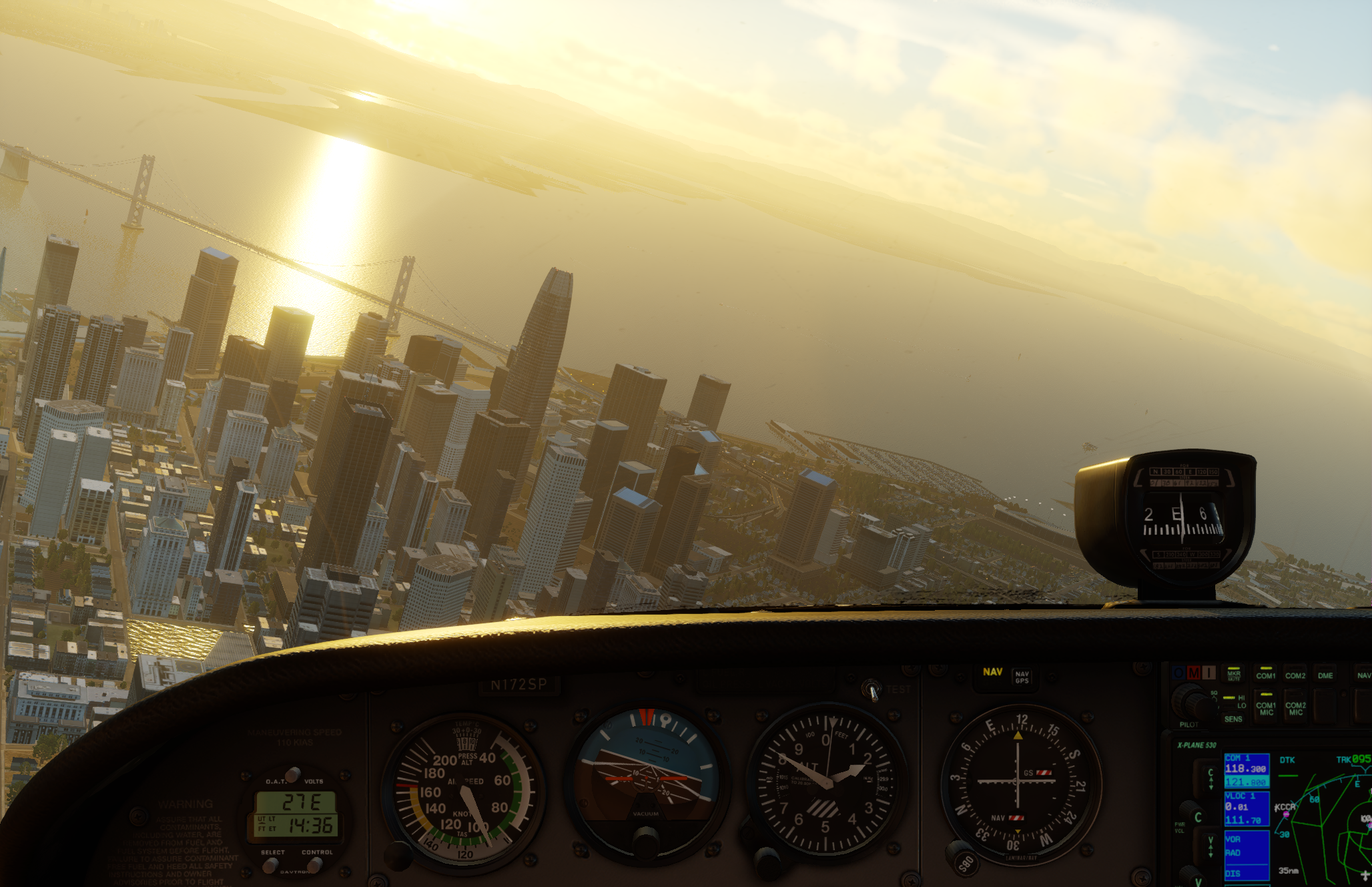
My sister-in-law was so kind as to give me the download code for X-Plane 12 for Christmas. I'd previously found its graphical improvements not quite impressive enough to justify the purchase, but the new lighting and shading model really shines when the lights go down in the cit-tay, and the sun shines on the baaaaaayyyy:

Downtown San Francisco seen in golden sunrise light from an airplane cockpit in X-Plane 12. There is bright sun glare reflected off San Francisco Bay, and the Bay Bridge is prominently visible.

It's also much better in garbage weather with rain and such, though that is harder to convey in a still image.

Graphically, they're playing a probably impossible game of catch-up with Asobo Studios' Microsoft Flight Simulator and its real-time streaming world derived from Bing Maps data. X-Plane still uses the old model of a static world stored on your computer, and relies on optional downloads from its user community (both freeware and commercial) to flesh out the parts of the world you really care about with add-ons. But that also means it's far less dependent on some outside server infrastructure.

But this computer can't run Microsoft Flight Simulator.

The San Francisco pictured above uses the data that ships by default with X-Plane. I was actually using a very detailed free add-on for San Francisco with X-Plane 11, which didn't have any special landmarks for that area in its factory download (so while the basic geography would be there, all the buildings and bridges and such would have been generic "autogen" assets). You can see that in X-Plane 12, a few landmarks like Salesforce Tower and the SF-Oakland Bay Bridge are represented pretty accurately, but there are still a lot of autogen buildings there.

The basic global geography download includes more or less accurate street layouts and coastlines for much of the world, but the shapes are relatively low-resolution polygons and one thing that does tend to take me out of the simulator immersion is when that's hard to ignore. You'll see a coastline with realistic-looking soil and vegetation, but following unnatural precise angles (in a place where human intervention shouldn't have created that in reality). The same is true of roads. The curved lozenge shape of the block across the street from me is there in the database, but sharpened into a parallelogram. I actually think they could do a lot to improve the basic visuals just by automatically putting some subtle curves on street bends and intersections, though they may be afraid of any deterministic process to do this going wrong in some situations.

I haven't tried using the scenery add-on I was using before in here yet, but I suspect it would work fine. Most of the scenery and aircraft add-ons for X-Plane 11 do work here, though some add-on aircraft that predate version 11 don't work or work badly. Some of the authors have made updated versions that use new features in X-Plane 12.

Users have created many libraries of free objects to use in these add-ons, and one of the frustrations of free user-created add-ons is that they often have a lot of external library dependencies which are hard to manage. I've noticed that the most popular add-ons tend to be the ones whose dependencies are simple or nonexistent. It seems like everything like this eventually evolves to needing a package manager.
mmcirvin: (Default)
Lots of people I know have been streaming onto Bluesky. My main venue for public microblogging has been my Mastodon account at mathstodon.xyz/@mattmcirvin for a while, but I have now given it a Bluesky mirror at mattmcirvin.mathstodon.xyz.ap.brid.gy, and Bluesky folk should be able to follow me there. There is not a lot there yet since it just started mirroring. We'll see how well this works.
mmcirvin: (Default)
One bug I remember vividly from Microsoft Flight Simulator 1.0 for MS-DOS, that I haven't been able to reproduce here, is that sometimes mysterious replicas of whole airports or components of them would appear at some distance from the original, probably because of integer math rollover. Either I haven't been able to reproduce the conditions in FS2 for Atari 8-bit, or they fixed it for that version (I don't recall seeing it on the Atari ST either).

I think the things most likely to do it in MSFS 1.0 were the little refueling depots (just a letter F in a square) that don't seem to exist in this version. I notice the manual tells you just edit your fuel level to keep flying when you run low. Most likely, the fuel thingies were positioned relative to the airport center with lower-precision math.

All versions of MSFS and Flight Simulator II have had a "slew mode" in which physics is suspended and you can just reposition and reorient the aircraft with six degrees of freedom using the keyboard. I recall spending a lot of time just moving around in slew mode, and just rising upward toward space--eventually, you'd encounter the outlines of a ghost airport hovering at a vast distance above the ground.
mmcirvin: (Default)
Bruce Artwick of subLogic became known for a simple flight simulator for the Apple II and TRS-80 Model 1. After he wrote the vastly more powerful Microsoft Flight Simulator for IBM-compatibles, he backported those new features to an impressive new version for the Apple II called Flight Simulator II, which he sold through his own company.

They then ported that to other 8-bit platforms, including Atari. I never actually had this as a teenager but I remember being impressed by the magazine ads for it--it was clearly basically Microsoft Flight Simulator, which I liked to play on my dad's Compaq, but for Atari? Amazing! It didn't seem to get a lot of attention, though, mostly because it was subject to the limitations of Atari's hardware. It also required 48k of RAM, and I think primarily shipped on floppy disk, which in the early years meant that only the more well-heeled users could play it. (Years later I bought the much better Atari ST version.)

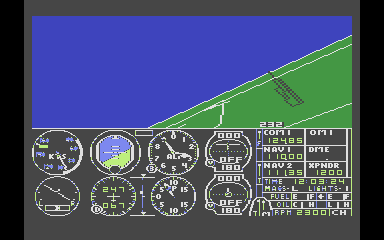
Atari, though, eventually put FSII for 8-bits out on ROM cartridge as, I think, the pack-in with the keyboard bundle of the XE Game System, their very late second attempt to rework the 8-bit computer platform into a game console. Out of curiosity I recently gave it a try. It looks, yeah, pretty much like the first version of Microsoft Flight Simulator:

Flight Simulator II for Atari 8-bit computers, with artifacting settings approximating the colors you'd see on an original Atari 400/800 with CTIA.

(I tried to do some clever stretching of the image to approximate the slightly non-square pixels that an actual CRT television connected to an Atari would have given you, but that doesn't seem to have worked. Anyway.)

It plays like Microsoft Flight Simulator, too, except that the Atari was even more CPU-bound than the original IBM PC so the best it can ever manage for the changing 3D perspective view from the plane is about 1 FPS. That makes FSII very difficult to play. It's a game of tiny touchy adjustments, best played with the keyboard. It actually is bound to the joystick, but since the Atari joystick was functionally a digital d-pad, all it could do was nudge the virtual yoke like a keypress, and you got more precision with the keyboard doing that.

One theoretical difference from MSFS 1.0 is that the civilian light plane being simulated is allegedly different: the early versions of MSFS (and some versions of FSII) all claimed their default plane was a Cessna 182, but here, it's a Piper Archer. I don't know why or if that actually makes any difference to the flight model.

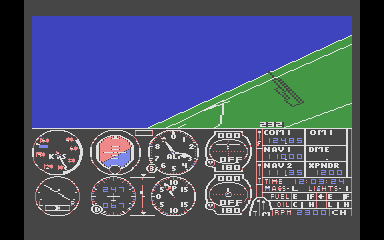
Actually, the colors above are the ones you would have seen on the original Atari 400/800. By the time it came out for the XE Game System, the colors in the bottom half would have looked a bit different--I think it would have been something like this:

Flight Simulator II for Atari 8-bit computers, with artifacting settings approximaing the colors you'd see on an XL or XE-series computer. The artificial horizon now has a pink top half and a blue bottom half.

I'm not 100% sure that's right. It was different, anyway.

But that's because the bottom half of the screen is actually in the monohrome high-res mode and using composite artifacting to produce its colors (like many things ported from the Apple II to the Ataris), and those colors were notoriously fickle, reversing when Atari went from the CTIA to the more advanced GTIA video output chip and then changing again in the XL/XE series. That's because they depend sensitively on the sub-pixel phase of the video signal, as I explained in this old post about artifacting on CRT televisions and composite monitors.

The top half, though, is not in that mode; it's in an actual 4-color mode, I think the one that Atari BASIC nerds colloquially called "GRAPHICS 7 and a half". So its colors were more stable between hardware revisions. Atari's ANTIC chip implemented a simple display list that allowed mixing modes in horizontal bands like this. I was pleasantly surprised to see that Flight Simulator was making use of it.

Regardless, I get the impression that this port was not well-loved, because the sluggishness of it even compared to Microsoft Flight Simulator 1.0 was a problem. Keep in mind, Atari owners were accustomed to the glass-smooth animation in more arcade-style games like Star Raiders, though the "serious simulation" aspect of this could excuse a lot to a person in a certain frame of mind. On an emulator, of course, you can remove the historically accurate speed limiter and play it at a higher frame rate that actually makes it fun, and since FSII's engine is not using the CPU for timing, it's still playable!

Still, the Atari ST version was much better, blessed with an 8 MHz 68000 to run the engine, and mouse-yoke support to make control a bit less painful.
mmcirvin: (Default)
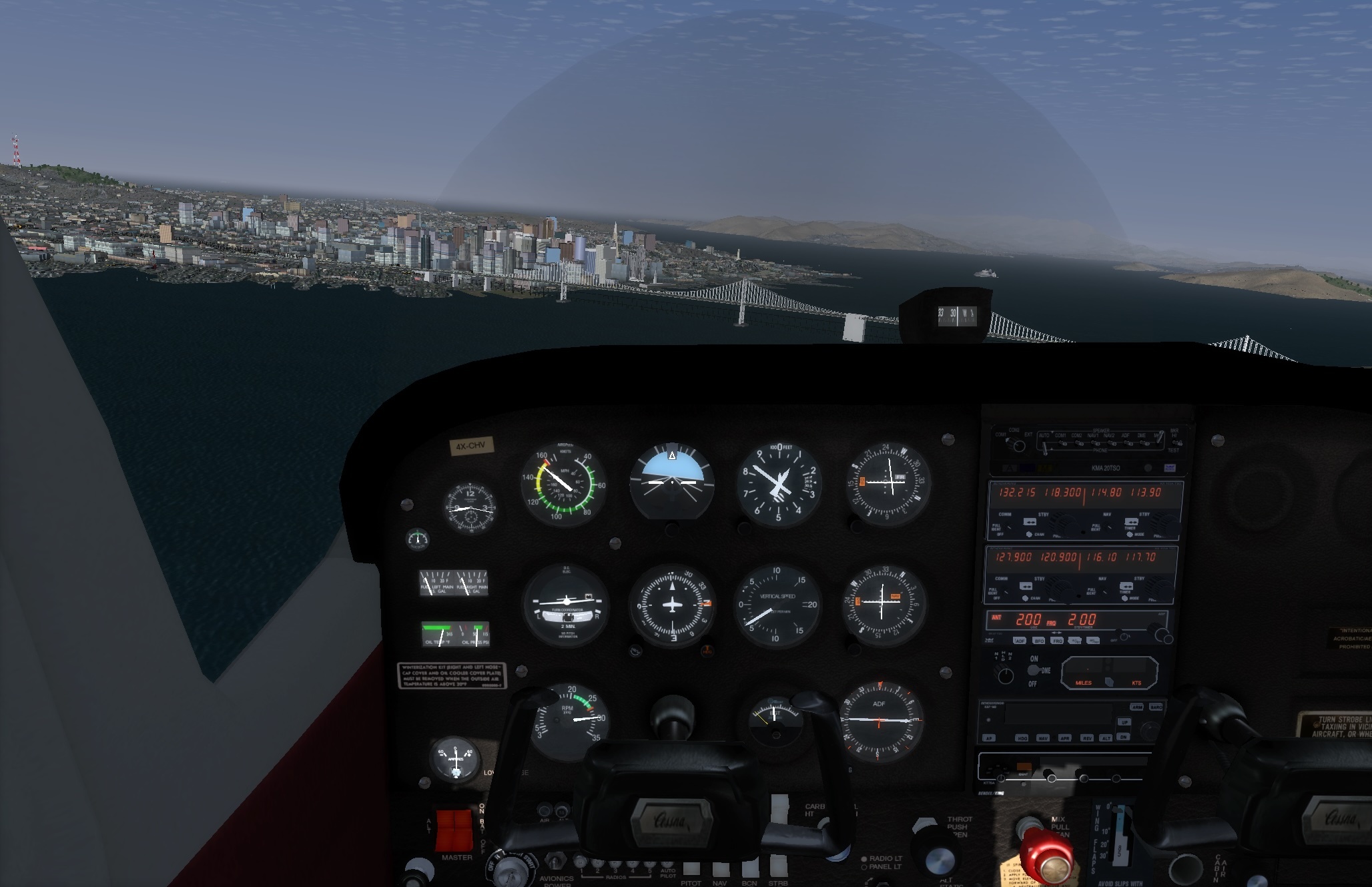
I don't think I posted about it back then, but one of the things I did when I was messing around with flight sims a few years ago was to download FlightGear, a sim that is actually free and open-source (more precisely it is GPL'd free software). It's been around since the 1990s, slowly being developed, and it does show its age, but you can't beat the price:

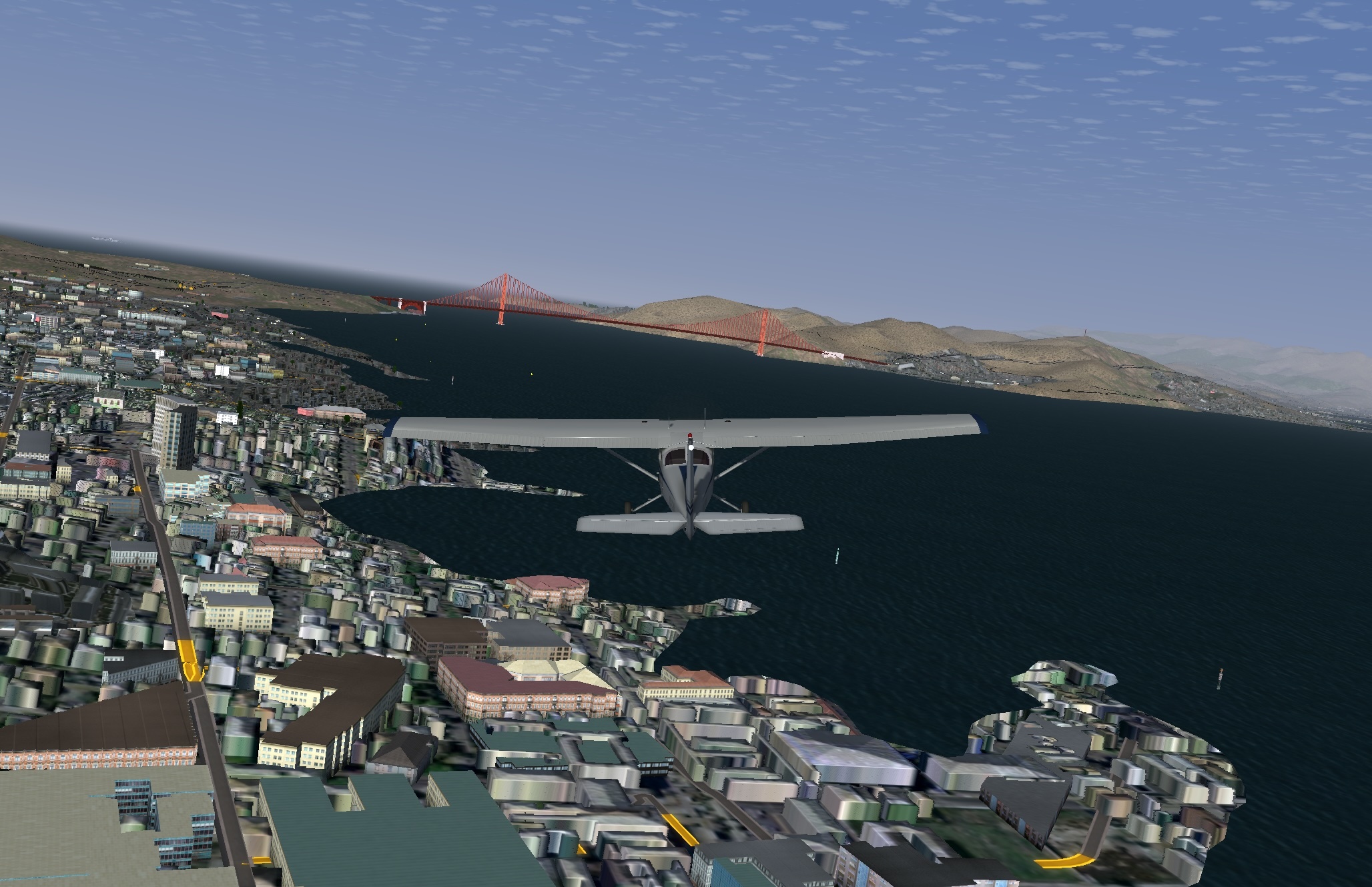
A screenshot from the FlightGear flight simulator, showing a view of San Francisco from the cockpit of a Cessna 172. Geez, I'm way overspeed.

A screenshot from the FlightGear flight simulator, showing a chase-plane view of a Cessna 172 over San Francisco.

When I tried it a few years ago, it seemed a bit awkward and glitchy, and I had no luck using it to fly anywhere other than its default low-res rendition of Hawaii. It's matured a little more since then (and my computer is more capable), and there's an automatic-scenery-download feature you can use to get world scenery for anywhere on the planet, though it doesn't download fast enough to stream and teleporting to a new airport will likely trap you in a gray void for a while. The autogen scenery makes many areas look kind of post-apocalyptic, in the manner of X-Plane with the specs turned way down, and its imagery of urban areas is schematic at best, but the airports are there.

It also now recognizes game controllers without much trouble, though the default mappings for the DualShock needed work much as with X-Plane (a centering analog stick is really not appropriate for controlling a throttle). With the controller set up correctly, FlightGear is actually fun to use.

The keyboard mappings seem inspired by the original subLogic/Microsoft Flight Simulator from the 1980s. Of course I had to take off from Oakland International and fly over San Francisco, the default area from Atari ST FSII.

It is still a bit glitchy--at one point my Cessna refused to budge from the runway even with the propeller going at full throttle, and after several attempts to check all possible ways I could have accidentally left the wheel brakes on, I Googled it and found a discussion of a known bug that causes this to happen sometimes until you toggle "Enable damage" on and off. The discussion was from several years ago, so, yeah. Some things happen slowly.

The frame rate it manages with the above settings is also kind of stuttery by modern standards, even on my new computer. X-Plane does much better with that. It is apparently possible to use it with a multi-monitor display, but it takes a lot of messing with configuration files and it was more than I was willing to do.

A charming detail is that the Cessna's engine will die if you just go immediately to full throttle after starting it--you have to handle it with realistic care, going easy on the throttle at first and ideally manipulating the fuel-air mixture and such. This is a bit annoying if you're just starting out but I kind of admire their insistence on that. The initial download only gives you the Cessna 172; there's a big library of free plane models you can download and install, but I haven't tried them. There are also a lot of scenery add-ons to make the local area of your choice look nicer.

FlightGear looks like a thing from a bygone age, and it isn't going to replace paid sims for me, but if you want something that costs $0 and actually models an airplane with some care, I doubt you can do better.
mmcirvin: (Default)
In my first burst of posts about flight simulators several years ago, I noted that the Easter egg flight simulator in Google Earth Pro tried to support game controllers, but didn't work well enough to be usable with them (it was an addendum to the post on X-Plane 11, which handles them with no trouble, though I did mess with the settings quite a bit there to make it work like I liked--back then, I think I was using an XBox One or XBox 360 controller hooked up through USB, rather than the slightly less ancient Bluetooth PS4 DualShock I'm using now).

Well, now it doesn't work at all. When I launch it on my current machine, going into the flight simulator mode with a controller active offers a "Joystick enabled" box that is checked by default, but if you leave that on, the simulation just crashes. Probably just as well, since it never centered correctly, which made joystick control basically unusable.
mmcirvin: (Default)
Last night, having properly connected a game controller to my computer, I booted up the Atari800MacX emulator and for the first time in ages I played through a whole game of Star Raiders, the Atari 400/800's true killer app and the granddaddy of the modern "space sim" genre.

This video is highretrogamelord playing it on the highest difficulty level (not sure if there are any cheats involved).


Star Raiders was basically a hybrid of the old text-based "Star Trek" game, and a first-person arcade space shooter like Starship 1. It had a bit of strategy to it: the galaxy is a grid of "sectors", and you're trying to wipe out all the enemies while keeping them from destroying your starbases, which they do by surrounding a starbase sector with enemy-occupied sectors on all sides for too long (like an attack in Go, the game that inspired the name Atari). Within a sector, you're chasing down enemies in three dimensions in a mostly smooth first-person perspective view that was just mind-blowing in 1979. You have limited energy and can take systems damage that affects gameplay in various ways; the starbases provide energy and repairs. Travel between sectors is by hyperspace jump, which is expensive and tricky. Your "rank" at the end of the game is computed from a formula that combines several aspects of your performance (the manual actually gave the formula).

I was playing it on Pilot, the lowest difficulty level that isn't baby/God mode (you can take damage, and have to manually fly the hyperspace jumps). Wow, I've gotten really bad at Star Raiders. I never got that good at it, I think because when I was a kid, its immersion was actually anxiety-inducing--a remarkable thing to say about a primitive game for an 8-bit personal computer.

But last night, I think I got the lowest possible joke ranking, even though I completed the game without dying and I think prevented any starbases from being destroyed. (It was a near thing--the *last enemy left in the galaxy* got in a lucky hit that took my shields down, and rather than continue to duke it out as a one-hit-point wonder I ran away to a starbase for servicing before coming back to kill it, and that probably dropped my score.)

I'd forgotten how tricky the "stay on the beam for the hyperspace jump" mini-game is. Mastering that is probably key because if you're not good at it, it doubles the number of expensive hyperspace jumps you have to do.

Seen with modern eyes, the game can get repetitive. But it successfully tugs at your emotions and it's got some interesting emergent strategy that comes out of the interaction of simple features, which is always something I like in a game. (For instance, how do you get to a starbase for repairs if your main engine is broken? The hyperdrive never goes out, so you have to initiate a hyperwarp and interrupt it until you're close enough.)
mmcirvin: (Default)
OK, I had also forgotten how much fun it is to have a proper game controller connected to your computer. For flight simulation, it's not a geeky realistic flight control but it's miles better than using the mouse to control an imaginary yoke.

Our XBoxes are so old that the wireless controllers for them aren't standard Bluetooth devices and I was wary of once again installing the increasingly sketchy third-party drivers to use them. But our PlayStation 4's Dual Shock controllers are just standard Bluetooth devices, and pairing one was not difficult at all. (Its battery was dead, to begin with, but it also works wired up through its old USB Micro port to my USB dongle, which charges the battery.)

X-Plane makes interesting default assumptions that I don't think are good for me: it maps one stick to roll/pitch and the other to the throttle up/down. I guess that makes some sense IF you have a separate pedal controller for the rudders, which I don't.

I mapped the left stick to the rudder, in lieu of pedals, and the right to the yoke. Up and down on the D-pad became throttle controls, and then the other buttons on the controller face became trim controls corresponding to the stick nearest them--because actually having a centering stick makes you appreciate what trim is for in a real aircraft; you want those. Suddenly it's possible to get your plane properly trimmed and leave it in very stable flight. Also, having separate rudder and pedal controls teaches you what the turn coordinator/slip-skid indicator is for. And if the mouse isn't controlling the yoke, it can be used to manipulate the other cockpit controls if you don't necessarily know the key commands (if any) that are mapped to them.

I guess the shoulder and fire buttons could be weapons controls for the fighter planes. Thought about mapping flaps to something but the keyboard is good enough for that.

It Just Works with the Stella Atari 2600 emulator, too, though the default mappings follow post-Nintendo game controller norms: your left thumb is operating the joystick and the fire button is X. That's not very Atari, is it? Maybe for a truer experience I should have the joystick control over on the right and the fire button at the upper left.
mmcirvin: (Default)
A few years ago, in the depths of COVID shutdown when I was probably hankering for a view of the big world, I went on a tangent about flight simulators. At the time Microsoft had just put out a spectacular ground-up reworking of Microsoft Flight Simulator, but I didn't have a machine that could run it, so I sprung for X-Plane 11, the most advanced one available for the Macintosh.

My MacBook Pro was already old and feeble at the time and could just barely run it. It worked, but the frame rate was pretty choppy under the best of circumstances, and the UI was kind of glitchy, and I could forget about running it on more than the laptop's built-in display--it would just get unusably slow.

Well, I recently got a new MacBook Pro with an Apple Silicon M3, and Apple's handy Migration Assistant dutifully hauled all of my old garbage over here where, remarkably, nearly all of it just runs without any trouble even though Apple has switched to a completely different processor architecture (for the third time)! I think the biggest thing that I did have to upgrade was Sagemath, but that's no surprise--that thing is a bear.

Amazingly, X-Plane 11 running under Intel emulation on this ARM-based computer is way smoother than it was running natively on the old one (this may be more down to this computer's relatively powerful GPU than anything else). And I can use a big external monitor as a second screen with no trouble at all, which makes flight simming a lot more fun.

X-Plane has had a version 12 out for almost two years now, which is Apple Silicon-native on Macs; I don't think my old computer could run it at all, but my new one can. I did download the free demo (which is the full product but limited to 15 minutes of flying around Portland, Oregon) and give it a try. The online consensus about it seems to be that, while it looks significantly better than X-Plane 11, it's not enough better to really be impressive in a world where Microsoft Flight Simulator exists, and for most people who bought version 11 it's not enough of an upgrade to justify springing for the rather high price.

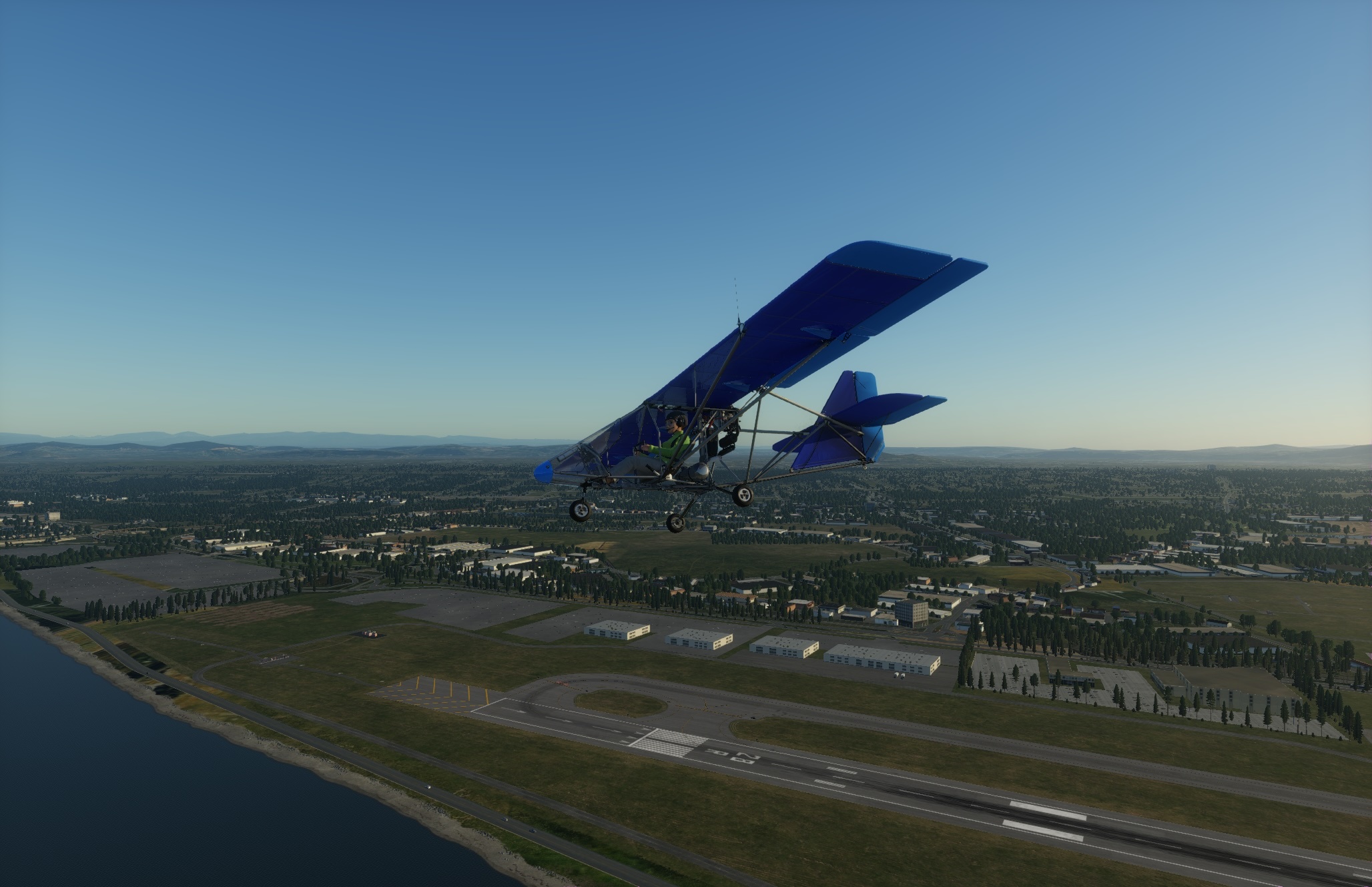
A screenshot from X-Plane 12 of an ultralight plane over Portland's airport in the late afternoon.

A screenshot from X-Plane 12 of the view from an ultralight over Portland's airport in the late afternoon.


(The pilots among them also debate whether X-Plane 12's flight model is better or worse, but this is so far beyond my expertise that I couldn't usefully comment. It does seem touchier--it seems much easier to crash the plane if you just mess around. But that might be realism!)

I think that's basically correct. The other thing I noticed is that X-Plane 12 is demanding enough that on its default settings, it makes my new computer stutter a bit. I'd probably have to dial back some of the bells and whistles to make it buttery smooth.

For now, I think I'm satisfied with running version 11 on this machine. And for pure sightseeing jaunts using realistic streamed scenery, I'm still better off using the toy flight simulator in the ancient "Google Earth Pro" app, which makes no pretense of very realistically simulating an airplane.
mmcirvin: (Default)
Funtown Splashtown up near Portland, Maine is the most major amusement park in New England that I hadn't yet been to (I have also not had the pleasure of visiting Santa's Village or Quassy), but my sister-in-law gave us tickets to there for my birthday. Sam and I finally used them last weekend, with the end of the season looming. We had a great time.

Coincidentally, the illustrious YouTuber Canobie Coaster just got back there and got some fresh POVs, so I can do my usual lazy thing of illustrating with other people's video.

Funtown Splashtown is, as the name implies, a dry amusement park joined to a waterpark; I'd say it's about the size of Canobie Lake Park except that relative to Canobie, it has less Funtown and more Splashtown. For today's amusement market, that's a sensible balance--you want a lot of waterpark. Crowds were very light on the dry side today but there was still a substantial wait for some of the waterslides, which always have pretty low capacity and relatively high demand.

Sam is more of a waterpark person so she spent most of her time on that side, whereas I mostly sampled the non-waterpark rides. But the one ride we did together, at the beginning and end of the day, was Funtown's spectacular new addition, a shooting dark ride called either Haunted Hotel (according to signs and promos) or Whispering Pines Hotel (on park maps and the ride itself). At any rate, the Whispering Pines Hotel is definitely haunted:


There's some lore about a witch's curse and an otherworldly realm with the hilarious name of "Dimension Dark X", delivered by a well-done animatronic in the queue. Your job is to shoot at clusters of purple LEDs representing the curse, or something, while all sorts of spooky manifestations appear. It's not a long ride, but everything looks really impressive for a ride at a park like this--it's easily the best dark ride in the region. I did find that scoring high required enough concentration that I ended up missing some of the effects, but that just encouraged re-rides. Later in the afternoon, the ride was an absolute walk-on (it seems to have good capacity), so this was pretty easy.

The horror in this ride is pitched at about the "Goosebumps" level, nothing too disturbing or gory, so it's pretty family-friendly but still scary enough that older kids will find it worth doing. A good call by the park all around.

But, of course, the ride I was itching to ride was the park's signature coaster, Excalibur:


This is an impressively big CCI wooden coaster from 1998 with a twister layout that mixes good drops and strong laterals, tucked away in the back next to the parking lot. You get there via the lightly themed "Camelot Bridge" that passes through a beautiful wooded area and over a stream--it feels like you're leaving the park entirely, a great touch. The station is themed like a castle and the train cars are labeled with the names of the Knights of the Round Table. It's not, you know, Disney, but it's some really great presentation for a small amusement park.

There are separate lines for the front row, back row (for the connoisseurs), and for all other rows. It's one-train operations and not particularly fast ones, but on the day I visited, this was not a big problem--the ride had more than enough capacity to keep the lines short. The ops were letting people get back on for re-rides, which is something I hardly ever see these days.

And this thing is running like a dream--honestly I was surprised and impressed; it's not so smooth that it doesn't feel like a wooden coaster, but there is no real rattle or buffeting. Apparently, this ride has been blessed with Gravity Group's pre-cut replacement track, which explains why it's tracking so well. This may be the best wooden coaster in New England at the present time, and in a field that includes Boulder Dash and Roar-O-Saurus, this is saying something.

(The park has a second coaster, a Wild Mouse that I actually could not ride, at least not without dragooning some random passerby into riding with me, because they were not allowing single riders and Sam definitely wasn't going on it. It didn't look like a big loss.)

After my first ride on Excalibur, I hit the park's flume, Thunder Falls. I don't have a good/legal POV of this, but here's someone's off-ride footage of the big splash:


This is billed as New England's tallest flume, and it probably is, though I don't know exactly how tall it is. I'd guess it's somewhere in the 60-foot range. After the splash, there are some coin-operated water cannons that people can use to shoot water at you when you're returning to the station, but nobody did that to me.

The other big must-ride I hit, and apparently one of Funtown's most famous rides, was the Astrosphere. Canobie Coaster just posted his POV of this one a couple of hours ago, which spurred me to write this article now. A content warning: this video does have a lot of flashing strobe lights:


Yeah, it's a Scrambler, running pretty fast in a dark dome with projected images, lasers, fog, disco lights and the sound system blasting ELO's "Fire On High." This is a great phantasmagoric experience but the ride is basically "Very Strong Laterals: The Ride" and it ultimately gave me a headache.

Canobie Lake Park has a ride along these lines called the Psychodrome, and in all my years going to Canobie I've actually never ridden it, but I ought to just to say I did it once. I think the show/music is different. These rides aren't really my cup of tea, though my sister loves them and always has. Anyway, Funtown's Astrosphere is reputed to be one of the best, so I couldn't pass it up.

It is quite a low-capacity ride, so it had one of the longer waits in Funtown. There were also quite elaborate safety spiels on the way in, some of the most involved ones I've heard for a ride. I suspect these are the result of some accidents that have happened in the past with these rides, most often involving the ride starting up when someone is standing in the way in the dark enclosure. They were being very very careful, it seemed to me.

All in all, a great day out. Even though Funtown Splashtown is a small park, there's quite a bit there I didn't get to that I'd like to do on a later visit: some of the waterslides (particularly the family raft slide), the bumper cars and bumper boats, maybe the go-karts which are actually included with park admission. There's also a truly enormous drop tower; I have not gotten into drop towers but who knows, I might someday.
mmcirvin: (Default)
Had a dream last night in which we had traveled to some distant city and were preparing to board an attraction that advertised itself as a kind of space tourism--but with carefully cagey wording that left open that maybe a trip into space wasn't actually what was happening.

I'd read an email from a friend who had ridden it, saying that the real fun of the trip was figuring out the gimmick they were using, and he wasn't going to spoil it for me.

Which just had me scrambling for spoilers to figure out what I was in for. In line to ride, furiously checking online reviews, I finally found one that gave a partial explanation: "Through clever optics, instead of going into space, riders are actually going up their own anus."

And then I woke up with more questions than answers.

I may have been thinking about immersive amusement rides too much.
mmcirvin: (Default)
We just got back from a ten-day trip to Japan, divided between Tokyo and Osaka. As a theme-park fan, one of the highlights of this trip for me was a one-day visit to Tokyo DisneySea, a park sometimes described as the best theme park in the world.

I can't say for sure that it is, but it is an astonishing place. As a Disney park, it's obviously not geared to thrill-seekers, though there are some rides with a thrill component there. It does have some of the most extravagant immersive theming I've ever seen, outstanding even by Disney-park standards.

That's probably because the Tokyo Disney resort has an unusual corporate status: while it appears in every way to be a Disney resort, Disney doesn't own or operate it. They just hire out Imagineering and license their IP under contract. It's owned and managed by OLC, a Japanese company whose largest owner is the Keisei railway, an operator of a number of rail lines including the Skyliner airport shuttle. OLC's sole job is basically running the Tokyo Disney resort, and its pockets are apparently deep. It's not competing with all of Disney's other cost centers and it's insulated from Disney's sometimes dunderheaded recent management decisions. What you see there is what you get when the ideas Disney Imagineering comes up with actually get fully funded.

The resort has your basic Disney resort setup: a bunch of hotels, a free-admission shopping area, and two large theme parks (Disneyland and DisneySea), all connected by a themed monorail. Unlike the Walt Disney World one, the Tokyo monorail is not free and has tickets and fare gates like any Japanese rail line, but fares are reasonable and you can get unlimited day passes.

Tokyo Disneyland is the classic Disney "castle park", closely patterned after Orlando's Magic Kingdom. I've heard great things about it--my sense is that it's a superior version--but we didn't go there. We'd allotted Disney one day out of our Japanese vacation and we wanted an experience you can't get anywhere else.

Tokyo DisneySea has its roots in a failed project to build a second California Disney park at Long Beach, as part of a development around the Queen Mary called Port Disney. That didn't happen, but many of the ideas ended up in Tokyo. There's even a replica ocean liner at one end of the park, the "S.S. Columbia", resembling the Queen Mary and containing a restaurant. The areas of the park all have port and sea-related themes, a couple of which are American: there's an "American Waterfront" which is themed after New York City in the early 20th century, and "Cape Cod", which is generally Massachusetts (there's a hilarious statue of Mickey Mouse as the Gloucester Fisherman, who is not on Cape Cod but I'm not going to quibble). So now I've been to Disney's Florida version of Japan and their Japanese version of Massachusetts. The theming is well-done and, as Sam noted, extends to planting vegetation approximating the various regions of the world.

Probably the biggest area is generally Italy-themed, with aspects of Venice and Florence. One of the most charming rides is just a Venetian-style gondola ride on a real boat with a real gondolier, who banters with riders (in Japanese, but I could appreciate the atmosphere at least). I found it more pleasant there than in the actual Venice, but that was probably more down to the season than anything else. Here's Michael Mastrile's video with a POV:


By freakish coincidence, the best day to go on our itinerary happened to be the opening day of a new large expansion called Fantasy Springs, a sort of second Fantasyland with attractions themed after Frozen, Tangled and Peter Pan. Access to Fantasy Springs was only possible with a special pass, and we decided to just not bother with it--the whole park was new to us, and Fantasy Springs would probably be jammed with people. This turned out to be a stroke of brilliance. Crowds at the rest of the park were quite light and even standby lines for the very biggest rides were not running over 40-60 minutes.

On top of that, we had some good luck: some English-speaking tourists who were visiting on some kind of resort package, and happened to be leaving early, gave us ride tickets that allowed us to use the local equivalent of a Fastpass or Lightning Lane queue (I forget the name) for a selection of rides, including Indiana Jones and 20,000 Leagues Under the Sea. Were they supposed to do that? I don't think so. Were we going to pass up that windfall? Also no.

We went on 20,000 Leagues Under the Sea twice, because we liked it so much and it was a mild ride we could all enjoy. It's one of the rides in the park's centerpiece area, Mysterious Island, which is Jules Verne-themed and built around an enormous fake volcano, Mount Prometheus. 20,000 Leagues seems to get some shade because of misplaced expectations: people seemingly expect it to be a major thrill ride and it's not. Instead, it's a suspended dark ride inspired by Submarine Voyage, but with only simulated submarine action. I think theme parks need these kinds of rides and they're a good complement to the more thrilling ones. You ride in submarine-themed ride vehicles that ride under the track, looking through large bulging portholes with bubbling fluid effects embedded inside of them, simulating passage in and out of the water and giving the ride an underwater appearance. We fight a giant squid with electricity, witness shipwrecks and underwater creatures and ultimately visit a strange Atlantean civilization (the book had Atlantis, but not living Atlanteans!) There's some kind of audio narrative that, like all of the rides here, is mostly in Japanese, but I didn't get the sense I was missing much by not understanding it. Here's LMG Vids:


Depending on where you sit, you may be looking out the front or side windows of the vehicle. The best view is from the front, but there are animatronics and figures in the scenery that are designed to be seen mainly from the side portholes, which adds to the re-rideability.

The tickets didn't get me into my #1 bucket-list ride, Journey to the Center of the Earth, so I had to do the full standby queue there. My wife and kid took one look at the ride's one visible moment (when the vehicles pop into the open near the top of Mount Prometheus, then plunge into the climactic, roller-coaster-like drop) and noped out of riding. So I went solo. The queue is entertaining, though, all indoors in a simulated cave with lots of steampunk scientific bric-a-brac and illustrations of the wonders to come, with English text.

Aside from some general flavor, the narrative here has almost nothing to do with Jules Verne's novel of the same name: in the ride continuity, Captain Nemo has been running a side project from his volcano base to burrow into the Earth with tunneling mole vehicles (more like Edgar Rice Burroughs' "At The Earth's Core"), and is now equipped to give you a tour of his discoveries. The ride system is the same one used in Epcot's Test Track or Disney California Adventure's Radiator Springs Racers. The vehicles are powered slot cars, actually running on bogies hidden under the visible floor, and the ride is divided into a dark-ride section and a fast-moving thrill-ride finale. In the dark ride, we wind through subterranean caverns with glowing crystals and mysterious fungi and other creatures, then encounter an animatronic lava monster like a giant segmented arthropod. That leads directly into the thrill-ride section: instead of Test Track's straight launch followed by curves, the ride vehicle is blasted up a fast spiral ramp (with strong lateral forces), then emerges into the open for an instant and plunges back into the darkness in the ride's final drop. It's an impressive ride with some mild thrills, nothing too extreme, but enough that my family didn't want to ride it. Here, again, is LMG Vids:


The last real thrill ride we rode was DisneySea's version of the Indiana Jones ride, which also exists at some of the other Disney parks. At Animal Kingdom, its counterpart is Dinosaur, a ride with a time-travel and dinosaur theme, but apparently that's going to be rethemed into yet another Indiana Jones variant. Anyway, Tokyo's is "Temple of the Crystal Skull." In these rides, you're in a ride vehicle that is also basically using the Test Track system, except that the vehicles also have a simulator motion bed that allows them to tilt and jostle around, simulating a jeep moving over rough terrain. You progress through a spooky temple with various traps and supernatural goings-on, occasionally encountering an animatronic of Indiana Jones, who urges you on through the ride while he tries to extricate himself from whatever trap he's fallen into. In this case, it's all full of angry skulls and skeletons (Attractions 360 video):


This was just a great ride. I rode it with Sam and I was worried that it might be too much for her, but she loved it. The physical thrills aren't on the roller-coaster level and it really puts on a show.

I did not get any creds, as the coaster enthusiasts say, at this park: the one large coaster here, Raging Spirits, is reputed to not be very good, and given that I preferred to hang with my family riding milder rides. But while I was off riding other things, my wife and kid did get rides on Flounder's Flying Fish Coaster, in the park's particularly gorgeous Little Mermaid-themed area:

dream creds

Oct. 9th, 2023 02:08 pm
mmcirvin: (Default)
I think about roller coasters more than I actually ride them, and I think there's nothing more emblematic of that than the fact that I seem to have several consistent credits that exist only in dreams.

I
think I dreamed about these rides a while ago, and every so often in another dream I remember that I actually have ridden them. Only these coasters don't exist in reality.

Most of them were at an entire park themed to dinosaurs, which was filled with these janky, rusting steel coasters themed to different dinosaur species and decorated like dinosaurs. In the dream, I think I supposed this park to exist somewhere in central Virginia. I suspect the rides were inspired by videos of Gao at the Japanese park Mitsui Greenland, a janky old "jet coaster" themed to a dinosaur, which I have definitely never ridden:


(The only dinosaur-themed coaster I *have* ridden is Roar-O-Saurus at Story Land, which is completely unlike these rides.)

Another one was a wooden coaster built underground in the basement of a building, descending several stories into the earth. There are a few coaster/dark-ride hybrids that actually resemble this (aside from being rather tamer and not as deep), but I've never ridden any of them.
Page generated Feb. 3rd, 2026 12:18 am
Powered by Dreamwidth Studios